

Thanks for the Microwave Oven!
- Posted by serter
- Categories Science & Physics
- Date January 25, 2019
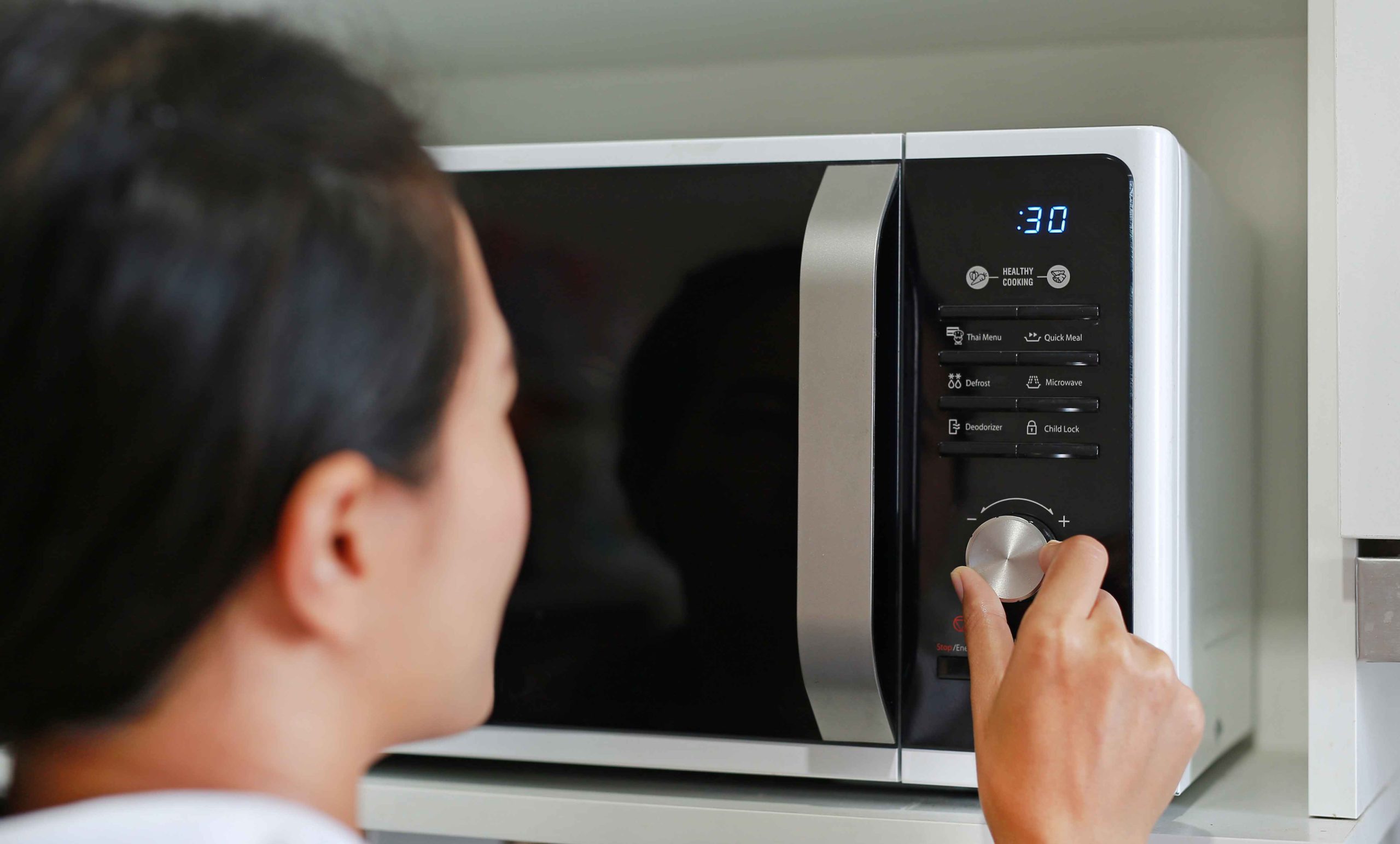
Melted chocolate in an American scientist’s pocket in 1946 led to the development of an appliance that changed the way many of us cook our meals today. Percy Spencer, a researcher at Raytheon in Waltham, Mass., was testing communications equipment when he noticed that his candy bar heated up when he stood near a magnetron, a vacuum tube that produces microwave energy. Microwave ovens heat food by exposing it to high-frequency microwave radiation.
Later in 1946, Raytheon filed for a patent for a microwave oven that could cook food. In 1947, Raytheon built the "Radarange", the first commercially available microwave oven. It was almost 1.8 meters (5 ft 11 in) tall, weighed 340 kilograms (750 lb) and cost about US$5,000 ($56,000 in 2018 dollars) each. It consumed 3 kilowatts, about three times as much as today's microwave ovens, and was water-cooled. The name was the winning entry in an employee contest.
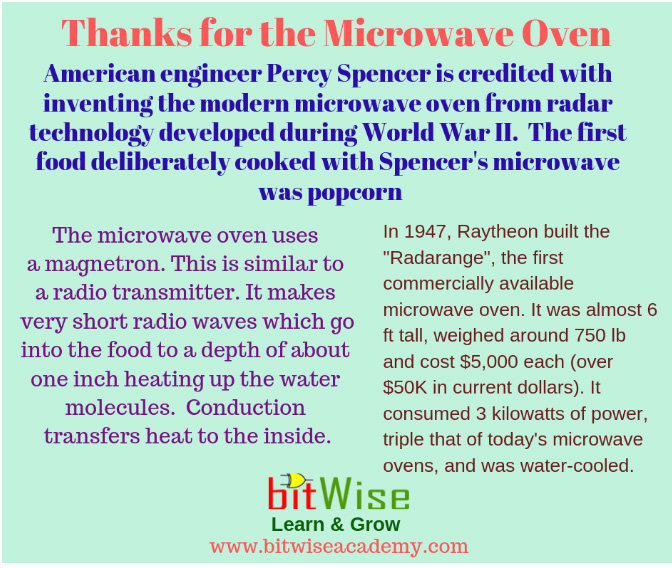
Microwaves are a form of electromagnetic radiation, which refers to the waves of the electromagnetic field, propagating through space. It includes radio waves, microwaves, infrared, (visible) light, ultraviolet, X-rays, and gamma rays. A microwave oven passes microwave radiation at a frequency near 2.5 Ghz. The microwave oven uses a magnetron. This is similar to a radio transmitter. It makes very short radio waves which go into the food to a depth of about one inch, heating up the water molecules. This makes water molecules twist about 2.5 billion times a second. As they heat up the heat goes to the inside of the food. Conduction transfers heat to the inside. This also happens in a normal oven, but microwave energy goes deeper so that the food cooks much faster. In an ordinary oven the energy stays mostly near the surface, so it takes more time. Metals tend to spark in microwaves, rather than heating. Metals like to lose electrons. When microwaves "push" on their electrons they just give the electrons away. A bunch of electrons or
